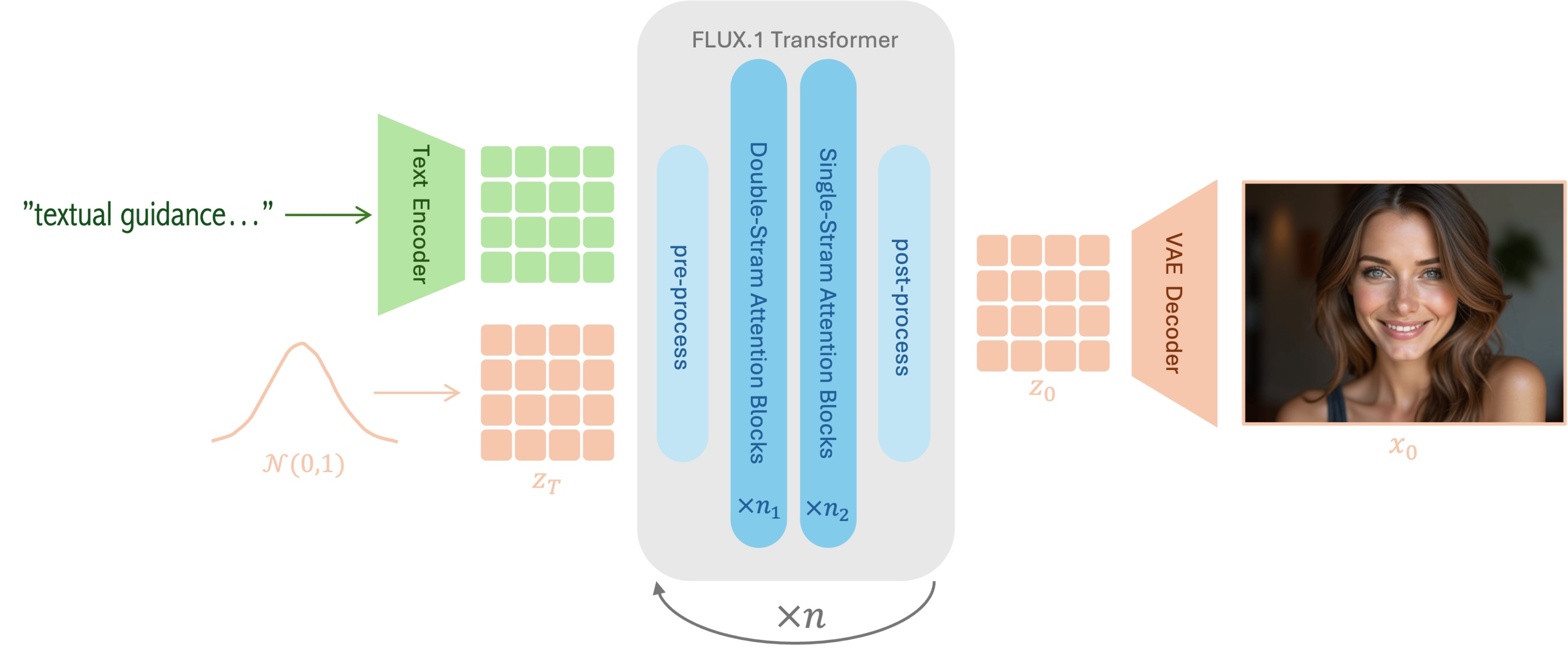
这 1 页拆解 FLUX.1 的 schnell、dev、pro 3 个版本,重点看模型结构、few-step 推理、text encoder 管线,以及它和 SD3 的差别。
FLUX = SD3 的 MMDiT 范式 × 工程优化 × few-step 蒸馏
FLUX 由 Black Forest Labs 开发。schnell 变体使用 4 步推理并采用 Apache 2.0 许可,适合在显存受限时做本地文生图实验。
| 维度 | SD3 / MMDiT | FLUX |
|---|---|---|
| Denoiser | 双流 MMDiT(text+image 独立流) | 单流 DiT(text+image concat 统一处理) |
| Transformer Block | 串行:attn → FFN | 并行:attn + FFN 同时计算后相加 |
| Position Encoding | 2D sinusoidal / learnable | 2D RoPE(Rotary Position Embedding) |
| QK Normalization | 无 | 有(QK-LayerNorm) |
| Text Encoder | 3 路:CLIP-L + CLIP-G + T5 | 2 路:CLIP-L + T5(去掉了 CLIP-G) |
| VAE | 16ch VAE(8× 下采样) | 16ch VAE(8× 下采样,自训练) |
FLUX 的 transformer block 让 attention 和 FFN 在同一 block 内并行计算:
SD3 串行模式:
\[ \begin{aligned} x &\leftarrow x + \operatorname{attn}\left(\operatorname{adaln\_norm}(x)\right) \\ x &\leftarrow x + \operatorname{ffn}\left(\operatorname{adaln\_norm}(x)\right) \end{aligned} \]FLUX 并行模式:
\[ x \leftarrow x + \operatorname{attn}\left(\operatorname{adaln\_norm}(x)\right) + \operatorname{ffn}\left(\operatorname{adaln\_norm\_parallel}(x)\right) \]并行模式减少了 1 次 kernel launch 和 1 次同步点,在相同参数规模下每步 forward 比 SD3 快约 15-20%。代价是训练更不稳定,需要 QK-normalization 来补偿。
FLUX 使用 2D RoPE,SD3 则采用 2D sin/cos position encoding。FlashAttention 已有 RoPE kernel 支持,这会直接影响实际实现的速度和维护成本。
| Encoder | Hidden Dim | Token 数 | VRAM(fp16) | schnell 可用? |
|---|---|---|---|---|
| CLIP-L (ViT-L/14) | 768 | 77 | ~0.9 GB | 必须 |
| T5-XXL | 4096 | 256~512 | ~5 GB | 可选(omit 可节省 ~5GB) |
受限显存策略:schnell 去 T5 是最舒适的配置,CLIP-L 单独 ~0.9GB,剩余 VRAM 留给 DiT 权重和 attention。
prompt → CLIP-L (768d) + (可选 T5 4096d)
          │
          ▼
    text embeddings concat → DiT input
          │
          ▼
  noise latent: (1, 16, 128, 128) @ 1024×1024
          │
          ▼
denoising loop: t = 1 → 0
  schnell: 4 步 (distilled, timestep 非均匀)
  dev: 50 步
  ├─ patchify(p=2) → (1, 4096, D)
  ├─ RoPE 位置编码
  ├─ parallel attn+FFN
  ├─ CFG (schnell: cfg≈0, guidance 内化)
  └─ Euler step: z_next = z + dt * v
          │
          ▼
VAE decoder: (1, 16, 128, 128) → (1, 3, 1024, 1024)| 维度 | FLUX.1-schnell | FLUX.1-dev |
|---|---|---|
| 推理步数 | 4 步 | 50 步 |
| CFG Scale | 0 ~ 1.5(guidance 蒸馏内化) | 3.5 ~ 7.0 |
| 每步 Forward | 1 次(不需要 uncond) | 2 次(cond + uncond) |
| Total DiT Forward | 4 次 | 100 次 |
| Wall Time(可用的 CUDA GPU) | ~2-5 秒 | ~30-60 秒 |
| Peak VRAM(1024px, fp16) | ~6-8 GB | ~12-14 GB |
| 许可 | Apache 2.0 | 非商用 |
schnell 的 CFG 内化是什么:
在标准扩散中,CFG 需要每步做 2 次 forward(cond 有文本 + uncond 空文本),然后按公式 \(v_{\mathrm{cfg}} = v_{\mathrm{uncond}} + s\left(v_{\mathrm{cond}} - v_{\mathrm{uncond}}\right)\) 合并。schnell 的蒸馏过程把这个"条件引导"能力内化到了模型权重中,模型在单次 forward 中就能产生相当于 "文本引导 + 无引导混合" 的结果。对中档显存卡来说,这意味着:每步仅需 1 次 forward,时间和显存都能明显减半。
| 维度 | SD3.5 Medium | FLUX.1-schnell | FLUX.1-dev |
|---|---|---|---|
| 参数量 | 2B | ~4-5B | ~4-5B |
| 步数 | 28 | 4 | 50 |
| CFG | 3.5~7.0(双 forward) | ~0(单 forward) | 3.5~7.0(双 forward) |
| Text Encoder VRAM | CLIP (~2GB) + 可选 T5 | CLIP (~1GB) + 可选 T5 | CLIP + T5 (~6GB) |
| Total VRAM(中等显存配置 配置) | ~5 GB(无 T5) | ~6-7 GB(无 T5) | ~12-14 GB |
| 质量 | 中等(2B 模型限制) | 高(4-5B + 4 步 = 出奇的好) | 最高 |
# 方案 1:schnell no-T5(最舒适,推荐)
pipe = FluxPipeline.from_pretrained(
    'black-forest-labs/FLUX.1-schnell',
    torch_dtype=torch.float16
)
pipe.enable_model_cpu_offload()
image = pipe(prompt, num_inference_steps=4, guidance_scale=0.0).images[0]
# VRAM ≈ 6.5 GB

# 方案 2:schnell + T5(质量更优,边界可跑)
pipe.enable_sequential_cpu_offload()
# VRAM ≈ 10 GB

# 方案 3:GGUF Q4 量化 schnell(最省)
# 从 HF 下载 city96/FLUX.1-schnell-gguf
# VRAM ≈ 4-5 GBFLUX 在 SD3 的 rectified flow + DiT 路线上采用单流 text-image 交互、parallel attention block 和 RoPE;这些设计分别简化模态交互、减少 kernel launch,并可使用 FlashAttention。schnell 变体通过 guided distillation 将 50 步压缩到 4 步,同时内化 CFG guidance,减少受限显存场景下的步数和双 forward 开销。对 diffusion_engine 而言,few-step scheduler 需要非均匀 timestep,CFG 内化则可以消除双 forward 瓶颈。
diffusion_engine/core/scheduler.py 中的 RectifiedFlowScheduler 可与 FLUX 风格推理兼容(\(t \in [0, 1]\),Euler step),但需支持非均匀 timestep 序列来适配 distilled 模型。attention.py 的当前实现使用可学习 position embedding,与 FLUX 的 RoPE 不同,toy 版本不急于实现 RoPE,但 T18 总结时需标注"真实 DiT 通常使用 RoPE 并配合 QK-norm"。