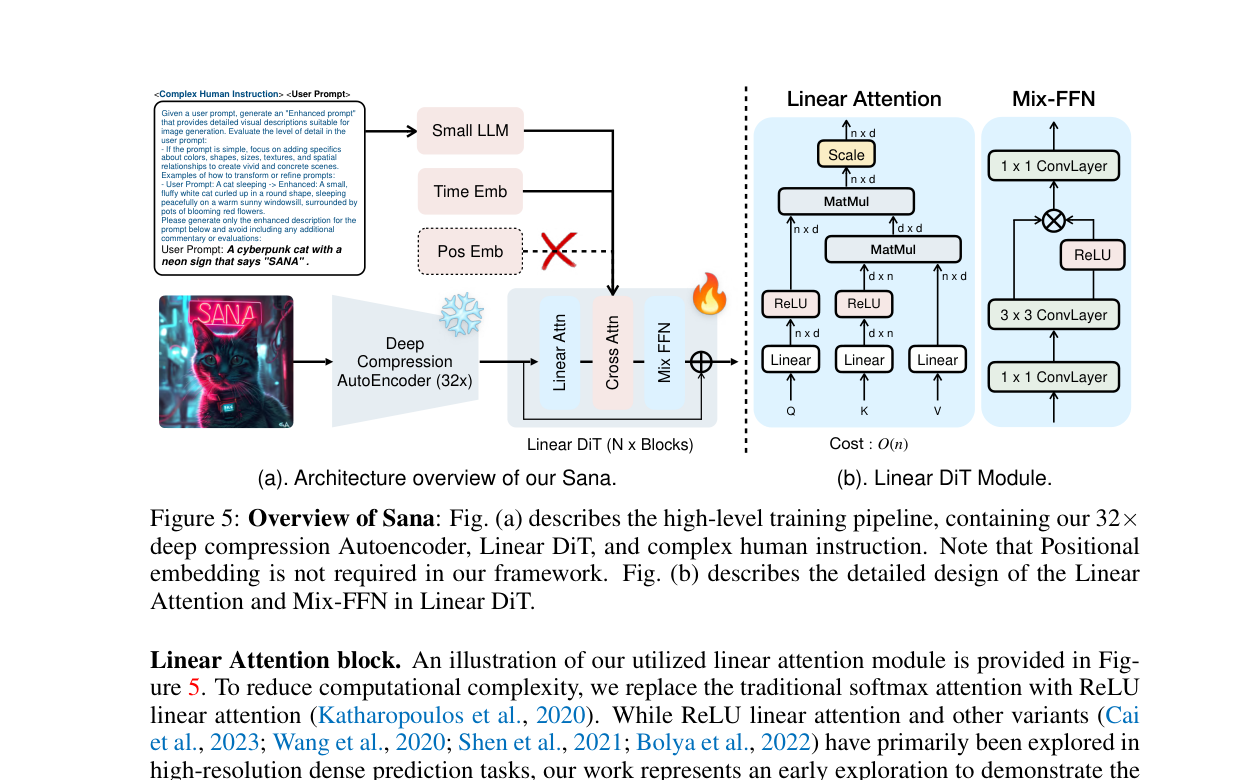
Sana 用 LLM text encoder、linear attention 和 SVDQuant 量化降低 DiT 的显存与计算开销,目标是在消费级 GPU 上生成高分辨率图像,包括 4K 档位。
扩散模型在高分辨率下的显存压力来自 3 个层面:
| 瓶颈 | 1024×1024 | 2048×2048 | 4096×4096 | 增长规律 |
|---|---|---|---|---|
| Image Tokens(p=2) | 4,096 | 16,384 | 65,536 | \(O(HW)\) |
| Full Attention 矩阵(fp16) | ~33 MB | ~536 MB | ~8.6 GB | \(O(n^2) = O(H^2W^2)\) |
| Text Encoder VRAM(T5-XXL) | ~5 GB | ~5 GB | ~5 GB | \(O(1)\) - 但已经很大 |
| VAE Decoder 输出 | ~12 MB | ~48 MB | ~192 MB | \(O(HW)\) |
显存问题:Full Attention 的开销按 \(O(H^2W^2)\) 增长。分辨率达到 4096px 时,仅 1 层 attention 的中间矩阵就需要 8.6 GB(fp16),已经超过不少消费级 GPU 的可用显存。可行选择只有降低分辨率或改写 attention。
| 对比 | SD3 / FLUX | Sana |
|---|---|---|
| Text Encoder | CLIP-L + CLIP-G + T5-XXL(总计 ~13B) | Gemma-2B(仅 2B) |
| Encoder VRAM | ~16 GB(3 个全载) | ~4 GB |
| Hidden Dim | 768 + 1280 + 4096 | 2304(Gemma hidden dim) |
| Text-Image 交互 | Joint Attention / Concat | Cross-Attention |
为什么小 LLM 更好:LLM(Gemma-2B)的语言理解能力远强于 CLIP(后者只能做图文匹配)。2B 的小 LLM 比 11B 的 T5-XXL 小 5×,但文本理解不输。Sana 用 cross-attention(text tokens 作为 K/V,image tokens 作为 Q)注入文本条件,而非 MMDiT 的 joint attention。这意味着 text tokens 不参与自注意力,进一步降低注意力复杂度。
\(O(n^2)\) Softmax Attention 的问题:
\[ A = \operatorname{softmax}\left(\frac{QK^\top}{\sqrt{d}}\right)V, \qquad Q, K \in \mathbb{R}^{n \times d} \]中间矩阵 \(QK^\top\) 是 \(n \times n\),需要 \(O(n^2)\) 内存。对 4096px 图像,\(n = 65{,}536\):
\[ 65{,}536 \times 65{,}536 \times 2\ \mathrm{bytes}\ (\mathrm{fp16}) \approx 8.6\ \mathrm{GB} \]Linear Attention 的原理:
令 \(\phi = \operatorname{ReLU}\)(也可使用 \(\operatorname{ELU}+1\)、\(\cos\) 等非线性核)。计算 \(\phi(K)^\top V\) 后,中间矩阵的大小是 \(d \times d\),与 \(n\) 无关:
\[ \begin{aligned} \mathrm{KV} &= \phi(K)^\top V \\ A &= \phi(Q)\,\mathrm{KV} \end{aligned} \]对任意分辨率,\(\mathrm{KV}\) 的中间矩阵仍是 \(d \times d\)。当 \(d=1536\) 时:
\[ 1536 \times 1536 \times 2\ \mathrm{bytes} \approx 4.7\ \mathrm{MB} \]| 分辨率 | Tokens (n) | Softmax Attn 内存 | Linear Attn 内存 | 节省 |
|---|---|---|---|---|
| 1024×1024 | 4,096 | ~33 MB | ~4.7 MB | 7× |
| 2048×2048 | 16,384 | ~536 MB | ~4.7 MB | 114× |
| 4096×4096 | 65,536 | ~8.6 GB(不可行) | ~4.7 MB | 1,830× |
| 4096×4096 (video, ×16f) | 1,048,576 | ~2.2 TB(不可行) | ~4.7 MB | 468,000× |
内存复杂度:Linear attention 的中间 \(\mathrm{KV}\) 矩阵是 \(d \times d\)(\(d\) 是 hidden dim,通常 1536),与 token 数 \(n\) 无关。它去掉了随分辨率按 \(O(n^2)\) 增长的 \(QK^\top\) 矩阵;\(Q\)、\(K\)、\(V\) 和输出激活仍按 \(O(nd)\) 增长。
Sana 配合 MIT HAN Lab 的 SVDQuant(基于奇异值分解的量化)将 DiT 权重从 fp16 压缩到 int4:
| 组件 | fp16 权重 | SVDQuant int4 | 节省 |
|---|---|---|---|
| Sana-DiT (1.6B) | ~3.2 GB | ~0.8 GB | 4× |
| Gemma-2B | ~4 GB | ~1 GB(可选量化) | 4× |
| AE(VAE 替代) | ~0.3 GB | 保持 fp16 | - |
| 总权重 | ~7.5 GB | ~2.1 GB | 3.6× |
SVDQuant 的质量损失 < 1%(按官方 benchmark),在推理中几乎不可见。
prompt
  │
  └─→ Gemma-2B tokenizer → Gemma-2B (2304d) → text embeddings
       pooled: last token hidden state (B, 2304) → adaLN
  │
  ▼
noise latent z_1 ~ N(0, I)  shape: (1, C, H/8, W/8)
  │
  ▼
denoising loop: t = 1 → 0 (20~40 步, Sprint 仅 2 步)
  ├─ patchify(p=2) → (B, N, D)
  ├─ Linear self-attention: φ(Q) · (φ(K)^T · V)
  ├─ Cross-attention: Q=image tokens, K/V=text tokens
  ├─ FFN + AdaLN modulation
  ├─ CFG: v_cfg = v_uncond + s · (v_cond − v_uncond)
  └─ Euler step
  │
  ▼
AE decoder → pixel image| 配置 | VRAM | 分辨率 | 步数 | Wall Time | 适用取向 |
|---|---|---|---|---|---|
| Sana-0.6B(fp16) | ~7 GB | 1024 | 20 | ~3 sec | 较小 fp16 权重 |
| Sana-1.6B(fp16) | ~10 GB | 1024 | 20 | ~5 sec | 1.6B 原始精度 |
| Sana-1.6B(SVDQuant int4) | < 8 GB | 1024~4096 | 20 | ~5-15 sec | 量化与高分辨率 |
| Sana-Sprint-0.6B | ~7 GB | 1024 | 2 | < 1 sec | 低步数延迟 |
# 受限显存示例:SVDQuant int4 Sana-1.6B
pipe = SanaPipeline.from_pretrained(
    'mit-han-lab/SVDQuant-int4-Sana-1.6B',  # 量化版
    torch_dtype=torch.float16
)
pipe = pipe.to('cuda')
# 此配置不使用 offload
image = pipe('一只柴犬在樱花树下', num_inference_steps=20, guidance_scale=4.5).images[0]
# VRAM < 8 GB(1024px);可进一步测试 4096px| 维度 | SD3.5 Medium | FLUX.1-schnell | Sana-1.6B (int4) |
|---|---|---|---|
| Text Encoder VRAM | ~2-7 GB(CLIP+T5) | ~1-6 GB(CLIP+T5) | ~1 GB(Gemma int4) |
| Attention 类型 | \(O(n^2)\) Full | \(O(n^2)\) Full | \(O(n)\) Linear |
| 权重 VRAM | ~4 GB (2B) | ~10 GB (4-5B) | ~0.8 GB (1.6B int4) |
| Total VRAM(1024px) | ~5-8 GB | ~6-10 GB | < 8 GB |
| 最大可行分辨率 | 2048px | 2048px | 4096px+ |
| 许可 | Open | Apache 2.0 | Open |
Sana 的三项改动都能量化:Gemma-2B 替代 CLIP+T5 后,text encoder VRAM 从 16GB 降到 4GB;linear attention 把 4096px 下的 attention 内存从 8.6GB 降到 4.7MB;SVDQuant 4-bit 量化把 DiT 权重压缩 4×。Sana-Sprint 再用 2 步蒸馏缩短推理。对 diffusion_engine 来说,这组结果说明 text encoder、attention 和权重精度都应做成可替换配置,不能写死为 CLIP、softmax attention 和高精度权重。
diffusion_engine/core/attention.py 需要从当前 softmax full attention 扩展出 LinearAttention 类作为替代实现(接口:接收 kernel_fn 参数,中间矩阵为 \(d \times d\) 而非 \(n \times n\))。text_conditioning.py 的接口不应写死为 CLIP,而应接受任意 encoder 的 hidden states(支持 CLIP、T5、Gemma 等)。memory_manager.py 需要"attention type aware"的显存预估,linear attention 不能用 \(n^2\) 公式估算。Sana 是 受限显存场景下 image reference inference 的首选。